Saturday, July 11, 2015

AIO

Hello from Acadia! 
I have been having so much fun here and have not had a chance to write.
Lobstering!

There is so much to learn, and I will try my best to fit everything in this post. Every morning after an amazing breakfast cooked for us by Chef Dave, we go on an activity. After we come back and eat lunch, we go out again, on an entirely different activity. The activities vary, including everything from tide pool ecology to geology hikes. We have graphed shorelines and studied amounts of species in a square foot of a tide pool. I have used a dichotomous key to identify different types of algae and created food chains and webs of specific ecosystems. At 5:00 PM, there is an optional seminar about something concerning the ocean and another lecture after dinner. Everything is so much fun! 
Hard at work!

A couple thousand years ago, most of Maine (along with Canada, Greenland, and many other places near the poles) were covered by ice a mile high. The glaciers moved and shaped the land in so many cool ways! The weight of the ice pushed down on the land, making sea level higher. Rocks and boulders got caught up in the flow of ice and ran over the earth, shaping and denting it. There are three kinds of glacial erosion: polishing (when the ice rubs the rock to a perfect smoothness), plucking (when pieces are yanked off of a bigger rock, creating jagged, uneven surfaces), and chatter marks (when rock or ice creates claw like marks in the rock). How cool is that? 

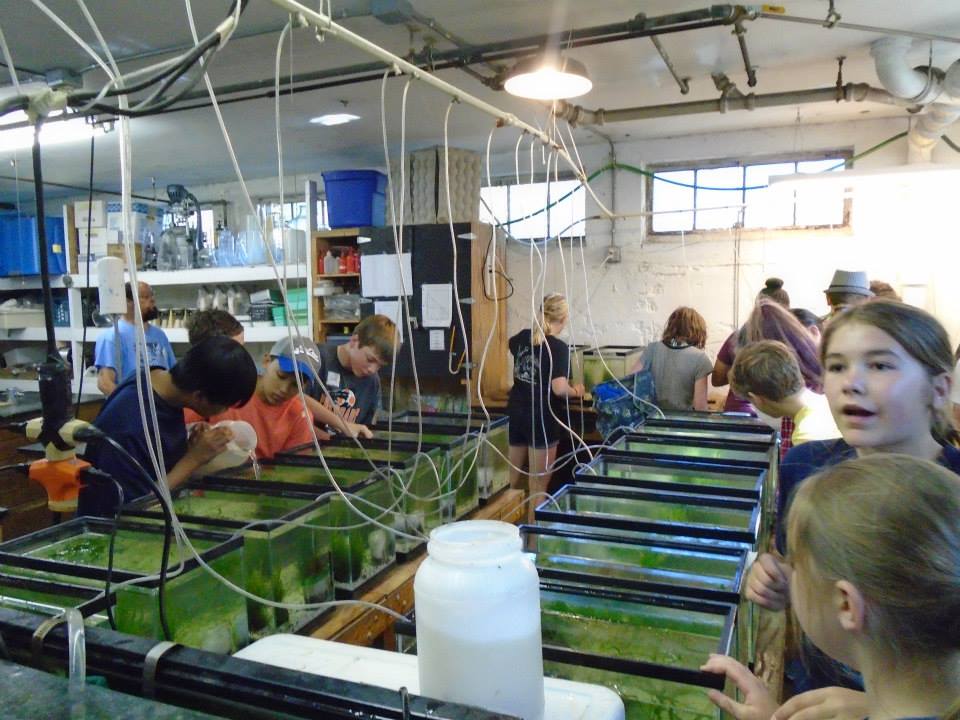
Everyone at AIO shares an aquarium tank with a partner. You collect things to put in your tank and then you have to go study your tank and make sure everything stays alive. This includes checking temperature, density, and salinity (the amount of salt in the water, which is usually measured in parts per million, or ppm.) It is important to make sure that the food chain in the tank is sustainable. You have to make sure that you have the right amount of producers (phytoplankton and algae), primary consumers (organisms like periwinkle snails, limpets, scuds, barnacles, and mussels), and secondary consumers (whelks, sea stars, and crabs). Arguably the most important organism in a tank is algae. Algae is defined as a unicellular or multicellular autotroph (something that photosynthesizes). They live in water, close enough to the shore to receive the sunlight they need. Algae are living organisms but are not defined as animals or plants. Algae are commonly known as seaweed. Algae is at the bottom of the food chain. It also provides oxygen through photosynthesis and gives many animals a place to live. As you can see, algae are very important to the ocean, but you need algae too! Sushi is wrapped in a layer of algae, and some toothpaste and soaps have algae in them too. 
The lab, where all the tanks are

Every night, we listen to at least one lecture, sometimes two. Each one focuses on a specific topic, such as whales, world fisheries, Jacques Cousteau, or birds of prey. I promise to post about what I've learned from some of these lectures later. 

On Sunday, we went on a whale watch but, unfortunately, didn't see any whales. We went back yesterday, and after looking at some puffins, seals, and porpoises, we were lucky enough to see a humpback whale mother and calf. We watched the whales surface, and the not-so-little baby whale really put on a show. We saw at least three full body breaches, as well as several other half body breeches. The whales also showed off their tail flukes for us! The crew of the boat was able to identify the mother whale as Fundy, a whale they had seen before. She was first spotted near the Bay of Fundy, which is how she got her name. They had never seen the calf before, and they are very glad to know that the whale population is still on the rise. The Humpback whales, or Megaptera novaenglae (which means giant winged New Englander), are a recovering species. The whales were so wonderful to watch and I am so glad to hear that we will be able to see them for many years to come. 
Crabs that we collected


Lastly, the other day we went on a crab survey. Before we left, we learned about native crabs (those that are made for the area they live in) and also some invasive species of crabs (those that have traveled into an area and adapted to live there). They are called invasive because, much like the Romans, they take up a lot of space and push the native crabs out. We collected as many crabs as we could in two minutes within a two and a half meter area. We then moved down a little bit and found thirty green crabs and only two Jonah crabs along our fifteen-meter piece of the rocky shore. Green crabs are an invasive species and have clearly invaded the area. Jonah crabs are native to the area, and we were surprised that they only represented a small portion of our data. We measured and identified all he crabs before setting them back in the rocks. 
I have been having so much fun here, I can't believe how quickly it's coming to an end! I'll miss it here!
Next week I'll be at hockey camp, but when I come back I'll be blogging about many more details of things I studied at AIO, including "some things you didn't know about Jacques Cousteau, and some things you did." 

Monday, June 29, 2015

Acadia Institute of Oceanography

Hello!
I am on my way the Acadia Institute of Oceanography in Seal Harbor, ME, near Bar Harbor. I will be spending the next two weeks participating in the AIO Intermediate program. I have never been there before, and I am so eager to learn more about fish, the ocean and being a marine biologist!
I've read that there will be labs, hiking, tide pooling, snorkeling, night walks by the shore and much, much more. I will be studying tide pool diversity, water samples, and some specimens we find! Cool, right?
I will post about things I'm learning, but I may not be able to download pictures right away. However, if you go to the AIO website you'll be able to see some pictures of the activities I'll be doing.
I chose Acadia because it has so many great opportunities to learn about marine concepts, and it is located near the easternmost point of the US and looking right out onto the North Atlantic Ocean, there are sure to be some incredible marine environments all around me. Plus, every time I talk to someone who has gone to AIO, I get even more excited!
I cannot wait to get to camp! More blog posts from Acadia!
--

Sunday, June 14, 2015

Blandings Turtles Release

Hello everybody,
I'm finally out of school, and yesterday I was able to set free the two Blanding's turtles that my class at school head started. To check out my previous post on these turtles, click here.
The two turtles, Cinnamon and Sugar, were about the size of a quarter when we received them, and they have grown so much over the past school year. Now, they each weigh around 75-85 grams, around the size of my fist! During the school year, my cousin, my close friend, and I spent our Friday afternoons with the turtles. We quickly became the 'turtle mommies' as we bonded with the turtles. Now, eight months after we first saw them, it was hard to say goodbye.
Cinnamon and Sugar were born in the Assabet River Fish and Wildlife Refuge, near Stowe, MA, and were sent to our school as part of the head start program. The goal of the program is to grow turtles in healthy environments so that when they are released in the wild, many of their predators are eliminated because the turtles are much bigger. The Blanding's Turtles were endangered at one point, and the turtles with only a 26% survival rate. The 110 turtles who were head started this year have an 80-90% survival rate- almost three times as high!
When we arrived at the refuge, we walked out to the mash area and stopped for a few minutes as the guide showed us two of the traps he had designed. They were used to keep track of turtles, and were made to keep snapping turtles out but let the smaller turtles in. There was a Painted Turtle in one of the traps, and he told us that people sometimes confuse the Blanding's and Painted Turtles. Painted Turtles have yellow stripes on their neck, whereas the underside of a Blanding's Turtle's neck is completely yellow. After setting the Painted Turtle back into the water, we walked down a little further to where we would be setting our turtles free. As the guide stepped out of the car, he had a box with him. He took the lid off, and I instantly knew who it was. "Sun?" I asked. He nodded, handing me the turtle. Sun was one of the two turtles I raised last year. He was so big when we set him free, that they wanted to put a tracker on him. We were able to look at a sheet of the size and weight of Sun over the past year. The guide told us that Sun was the biggest Blanding's Turtle of her age group.
After taking a ton of pictures, we weighed the turtles. We also recorded the carapace (top of the shell) length and width, plastron (underside of the shell) length and width as well as the height of the turtle. Then, with our last goodbyes, we set the turtles  down into the marsh and watched them swim away. Good luck, Cinnamon and Sugar!

Saturday, May 16, 2015

Cleaning Boston Harbor

Hey everyone,
Sorry I haven't posted in a while - I've been super busy! I am really excited to share with you the
Environmental Activist project I am doing in my science class with two of my friends. We decided to do our project on pollution in the Boston Harbor. Here's a quick overview:


Just pickin' up some trash

Boston Harbor was once one of the most polluted waterways in the nation, and it is in the final stages of a major cleanup. The cleanup program has been going on for 30 years, and the goal was to clean out 300 years worth of pollution. Over the course of the cleanup, the environmental quality has improved significantly, as well as eliminating industrial waste and sludge that was being dumped into the Harbor.
Did you know that each year about fourteen billion pounds of trash are deposited into the ocean? This pollution in our oceans mainly consists of plastic, pesticides and herbicides, oil, sewage, and other garbage. Sea life is dying from choking, internal blockage, and injuries sustained from plastic, fishing wire, and other kinds of litter, as well as oil and other toxins.
Most of the trash we found was down by the waterline.
Our goal is to help protect the harbor from becoming as polluted as it was before the $3.8 billion cleanup program, and to help keep the underwater environment of the Boston Harbor safe for the animals that live there.
On Sunday, we went into the harbor to pick up some trash so that we could better understand the pollution (where, how much, what kinds) for our project.
We found a total of 10-20 pounds of trash!
The outing was really great, and we learned a lot of things that we needed to know for our project. We learned that in the parts of Boston where people live is very nicely maintained. A lot of work is put into making the harbor side look nice for locals as well as tourists. However, as we walked farther north and away from homes and neighborhoods, we noticed that there was a lot more trash. There were pieces of plastic, cigarette butts, bottle caps, to-go cups, styrofoam pieces, glass, plastic bottles, and much more. Someone had even left their bike, which was rusted on the rocky waterline. As we picked up all of these, we noticed that there were significantly less trash cans around the area. If there were more trash cans in the area, would people be more inspired to throw out their trash?
After a short time, we estimated that we had picked up between 10-20 pounds of trash. Unfortunately, we couldn't stay and pick up more, but we had a great idea of what our next steps should be. Our project 'to-do' list now includes


  1. Email/write to businesses about trash around their property and ask them to put trashcans outside their facilities.
  2. Raise money to buy trash cans where there is a lot of trash but no trash cans
  3. Get people to pick up litter whenever they see some (hanging up signs, posting an inspirational video, ect.)

Help keep bags like this out of the harbor

I will keep you posted on our project. Until then, a few things you can do to help keep our oceans clean are:
Don't litter and pollute the ocean; if you see some plastic or other trash, pick it up; and most importantly help others to understand the consequences of marine pollution. This has to be a group effort.
So stop telling yourself that it's not your problem.
Stop reassuring yourself that someone else will clean up your mess.
Start asking yourself what you can do.
Start helping us to help the harbor.                     

Monday, April 20, 2015

NEAQ MBIT

·       For the last six weeks, I have been participating in an exciting class at the New England Aquarium. The class, Marine Biologist In Training (MBIT), takes place every Saturday for six hours. Yesterday was my last class, and although I was sad the class was over, I learned so much in such a short time! There were about 20 kids, and three great and informative instructors.
·        
·       The first big question was: what is a fish?
·       "A fish is a limbless, cold-blooded, vertebrate animal with gills and fins that lives wholly in water."
·       Of course, there are always exceptions. For example, the mud skipper can hop in and out of the water if they are being chased.
·       There are 32,000 species of fish (that we know of)! 47% of fish live in freshwater and 52% live in salt water. For those of you who did the math and figured out that 47% and 52% only add up 99%, the other 1% of fish are anadromous, meaning that born in freshwater, spend
·       Description: https://blogger.googleusercontent.com/img/b/R29vZ2xl/AVvXsEi0_7eo4WqXKjtrNZWdE3mk2rNJwSW6hFNQTFSt_lqd5W2tChtWENl4ZZ6BywakGvAvs7sd-Q2hNrTHIJSLxrZ1Snni3lENw2p6lRdAnKwcLrB3prTxY0yv-v0A5UydYQFm8kreR_JsaYQX/s1600/unnamed-3.jpg
·       most of their life in the salty sea, and come back to freshwater ponds to spawn like herring or salmon. Here are a few of the best fun facts I learned:
·        
·       Did you know that tuna are cold-blooded and live in cold environments, but can move their eyes and watch out for predators and prey because their eyes are warm-blooded?
·       There are three different kinds of camouflage:
·       Cryptic camouflage, where the fish blend in with their surroundings, either dynamically or they are just naturally that color.
·       Disruptive camouflage, where the fish is striped. This can be confusing to any predatory fish, because most have terrible eyesight.
·       Counter shading, where a fish is blue on the top and white on the bottom. The blue top looks like the ocean from any birds above, and the white underneath would look like sky to any fish hunting from below.
·       During the first class, we talked about what defines a fish, and the importance of fish.
·       In the next class, we talked about fish anatomy and conducted dissections of dogfish, sting rays, and a flounder! We were able to open up the stomach of one of the dogfish and we found a few small squid in her stomach.
·       The week after, we talked about fish habitats and took a behind-the-scenes tour of the aquarium! We saw where the sick fish are kept (the ill ones as well as the really cool 'sick' fish) and where the extra, too young, or stressed fish live. We also started talking about herring and the Weymouth Herring Run. We talked about how different stakeholders effect and are effected by herring, and how the Herring population are being depleted and why, as well as what the stakeholders can prevent it.
·       The next week, I unfortunately had to miss, but the class went on a field trip to the Weymouth Herring run. Cool, right?
·       The second to last class was more of the same, exploring the aquarium and talking about the Herring in preparation for our debate the next week. The coolest thing we learned was how some of the fish in the Giant Ocean Tank are fed, and what they eat. Then, we got to feed them - how awesome is that!
·        
·       Finally, we reached the day of our debate. We each argued for what we thought the best solution to the depletion of herring would be, where the money would come from, and how we would go about solving it. In the end, we decided that priority one was to educate the public of Weymouth on the issue and that priority two would be to take out all the invasive species in the ponds where herring come to spawn.
·        
·       We ended the class with an aquarium-wide scavenger hunt (which my team won)! We had to scour the aquarium for names of venomous fish (like a lion fish), depressiforms (like sting rays or flounder), compressiform fish (like an angelfish), fish with superior mouths (like a banded archer fish, hatchetfish), interior mouths (like a catfish) and fish with barbels (beard-like things, goatfish or catfish have them).
·       For the last hour, we had a little party with pictures, music, and certificates. I am now a fish expert - feel free to comment any fish questions you may have! To check out the NEAQ website and any other exciting programs they have going on, click here. All in all, it was a inspiring and interesting experience and time well spent!

Friday, April 17, 2015

A Week in Grand Cayman, Part two

Hello,

Remember that trip to Grand Cayman I went on? Well, here's part two of my adventure!

One day, we rented a boat to take us to all the good sites. We went to Sting Ray City, Starfish Point, and the Mangrove Forest!

At Starfish Point, we were able to find some starfish and look at them up close! Starfish have a super cool anatomy. When they get scared or freaked out, their exoskeleton hardens like a rock, and when the relax, their exoskeleton relaxes too and they soften a little. Then their tube feet start exploring and suctioning onto their surroundings! Once they have suctioned themselves onto your hand (this happened to me) you can't pull them off. You just have to tap on the top of their body, and they'll stiffen up and let go of you! The only downside to starfish is that they are not very interactive, and they are about as slow as a snail.
The next stop was the Mangrove Forest! There are three different types of mangrove plants, red, white and black mangroves. In Grand Cayman help to protect the island from weather, and so they are valued and protected. FUN FACT: Mangroves get a lot more salt then they need living in the ocean, and each kind of mangrove deals with the excess salt differently. Red mangroves has a sacrificial leaf to which all the extra salt is sent until it dies and falls off. Then the plant chooses a new leaf and the process starts all over again! White and black mangroves excrete the salt through hundreds of tiny pores on their leaves. Cool, right?

Our last stop was by far the best. Sting Ray City. As we slowed to a stop slightly outside the gathering of other boats, I could see tons of dark, round shapes moving under the water. We were told to get out of the boat, but not to wear flippers. In the shallow water, we watched in awe as a sting ray swam right over to the guide, and lifted the tip of its body out of the water. The guide was on his knees in the water, and at eye level with the ray. The tip of the ray came peeking out of the water again, and it stayed there until the guide kissed her on the nose. While holding the ray, the guide told us that her name was Sofie, and that she was his favorite. We learned that she was pregnant, and that she LOVED squid. A Sting ray's mouth is located on the underside of it's body, and they eat like vacuum cleaners - just sucking up whatever is underneath them! Sting rays also have a symbiotic relationship with a fish called the Bar Jack. The Jack receives all the food the sting rays don't want, and in return, they act as a "rearview mirror" for the rays. The Rays aren't really able to see behind them, but if they sense that their partner is scared or fleeing, they will do the same. I got to hold her, pet her, kiss her and feed her. Wow - it was such a wonderful experience! Since Sting Ray City is such a popular tourist attraction, it is estimated that each ray is worth half a million dollars of income to the island per year! After many final goodbye kisses, we got back on the boat. Although we were sad to leave, the smiles on our faces were quite a bit bigger (and our faces were significantly more sunburned) then when we had left the hotel.

It is hard to put into words how wonderful this trip was. A great mix of fun, exciting and educational!
Sofie - I hope to be able to come out to see you again soon!

Thursday, April 9, 2015

A Week In Grand Cayman

Hey guys,
Me, snorkeling
Keep your friends close, anemones closer. Get it?
SQUID!
I just came back from spending five days snorkeling in Grand Cayman, and let me tell you - it was so wonderful to get out of freezing cold Boston and into the hot sun! I thought I would share with you some pictures of the fish I saw and a little bit about the trip.

On Monday, we arrived in the afternoon and went for a quick snorkel to check that all our gear fit and was working properly. We didn't see that many cool fish during this particular swim, although we did see a grouper and a puffer fish as well as many smaller fish. That evening we went on a night dive. It was really different and super cool. We saw six or seven Caribbean lobsters, two spotted moray eels, a multitude of sea anemones and sea urchins, a very friendly squid, two green sea turtles and an eagle ray. Since it was nighttime, we were able to see some really awesome bio-luminescence created by plankton-like creatures. These tiny animals light up like a firefly to scare, confuse, or distract predators, as well as attract and call out to friends.

On Tuesday, we put on our flippers, grabbed our cameras, and swam out to a reef. Wow! The coral was so pretty and bright and the fish were amazing! I kept trying to get a picture of one really pretty rainbow fish. I chased him for five minutes because I couldn't figure out what kind of fish it was, and I wanted to get a picture. Unfortunately, the fish did not want his picture taken and hid inside some coral. Anyway, We saw more caribbean lobsters, a ton of beautiful fish and even another turtle! I was exhausted by the end, but it was worth it!

On Wednesday, we swam out to Governors' Reef - more awesome fish, coral, and the most beautiful colors! Some of the fish we saw included a rainbow fish like the one from Tuesday, a barracuda, a grouper and a school of very curious and friendly purple fish. This was our last snorkel trip, and we wanted to have as much fun as we possibly could!

All in all, the trip was awesome, and I learned a ton!!! Just the kind of warm getaway that I needed, plus - the Marine Biology aspect made it the best possible trip! I cannot wait to go back!