Tuesday, September 29, 2015

Sharkwatch

Hello, Oceanoblographers!

Last weekend, I went on a shark and whale watch hosted by the Atlantic White Shark Conservancy (AWSC) and the Whales and Dolphins Conservation (WDC). The motto of the AWSC is 'awareness inspires conservation", and the WDC's motto is 'a world where every whale and dolphin is safe and free.' Together the two organizations raised $18,000, which will be used to fund their education and research programs. Greg Skomal, the leading shark scientist in Massachusettes, went out on this trip the weekend before us, and he commented "To actually show these folks White Sharks and to see their reaction... I'm watching them!"

We arrived at the dock in Plymouth MA, at 7:30 am, and boarded the Son IV, well-equipped to spend the day out at sea. The anticipation level was high as we set out to sea! The fog made it hard to see where the sea met the sky, but as the day progressed, the fog burned off, leaving us with a beautiful, sunny day. As we travelled out to the cape, and around Provincetown at the tip of Cape Cod, and around to the northeastern coast, we kept our eyes peeled as we listened to Wayne Davis' communications with the captain.

We saw many interesting things, including humpback whales, finback whales, minke whales, great white sharks, lots of cool birds, and even a mola mola- one of the weirdest things I have ever seen in the ocean. I also had a chance to talk to several scientists, naturalists and marine biologists, as well as the founders of the AWSC. Even though I had to wake up at the crack of dawn, it was totally worth it!

I learned so much about all the animals that we saw, and I have collected so many facts that I would like to share with you, that I have decided to do three separate posts- the sharks, the mola mola, and the whales. Stay tuned for the sharks... dun dun!


Wednesday, September 9, 2015

The Complex Ecosystem of the California Channel Islands

Hello!
I just got back home from being in Santa Barbara, and while I was there, I visited the Santa Barbara Museum of Natural History Sea Center. There, I learned a lot about the Channel Islands in California, and the wildlife that lives there.
Garibaldi Fish
The Channel Islands are an archipelago of eight islands off the coast of Southern California. The islands are an interesting mix of hot and cool currents and are located at the border of two tectonic plates. Thirty-five years ago, five of the Channel Islands were named National Marine Sanctuaries, in hopes of protecting the thousands of marine creatures that live there. A unique environment, the Channel Islands are home to over 100 species living only in that area. You can find all sizes of animals and plants there, ranging from huge whales to bioluminescent jellies to tiny plankton. One of the really fascinating fish I saw at the aquarium was the state fish of California- the Garibaldi. Native to the kelp forests around the Channel Islands, the Garibaldi lives nowhere else. This brightly colored fish is named after Giuseppe Garibaldi, a figure in Italian military and politics, whose followers, and supporters wore bright red and orange shirts.
Kelp and kelpfish
One thing that I really enjoyed seeing - or rather, not seeing - was the camouflage. Many of the species can blend into the rocks, ocean or even the kelp! One fish- called the kelpfish - is the exact shape of a kelp leaf and can change colors to blend in perfectly. Some other fish were the exact color of the rocks and were totally hidden. Even the needlefish was easily mistaken for a piece of grass-like algae.
Something that the aquarium did that was really impressive was replicate the conditions of the kelp forests. Whether it was the water temperature or cloning the waves surging in their "Surge Tank", it was especially enjoyable to be able to see the fish in an environment so similar to their own.
Needlefish
Finally, after hanging out with some jellyfish, nudibranchs, and even an octopus, it was time to leave. The aquarium was very educational, and the exhibit made me want to visit one of the eight islands, both above and below the water,  on my next trip to Southern California!

Monday, August 31, 2015

A visit to the Chatham Shark Center


After listening to Dr. Marshall, I was inspired to take a trip to the Chatham Shark Center here in Chatham and learned a ton! Carcharodon carcharias, or Great White Sharks, span across most oceans in the world and are usually between 15 to 18 feet long, although the longest shark in recorded history was 20 feet. Great Whites are older than dinosaurs, appearing over 400 million years ago- 170 million years before dinosaurs. Great Whites are the largest predatory fish, have around 300 teeth, and they grow in rows, so whenever a shark looses a tooth the one behind it grows in and another tooth begins developing in the back. Sharks have six senses; the five that humans have as well as an electromagnetic field. They have what is called an lateral line down their sides filled with a fluid that reacts to vibrations in the ocean. Sharks seem to gravitate towards Chatham every summer in pursuit of seals. Recently the seal population has increased, drawing sharks here to the warm summer waters of the Cape. Because of this, scientists, the most well-known being Greg Skomal, have been studying sharks here; tagging them and taking samples. Transmitters are attached to the dorsal fin and are used to track the activity of the sharks. I love learning all these things about sharks, and I hope you enjoy learning these facts too!
In August, I attended the Sharkfest Gala at the Chatham Shark Center. The coolest part was after the silent and loud auctions when a scientist from the International Fund for Animal Welfare (IFAW),  an organization located in Yarmouth, Cape Cod,  gave a short speech about the organization and her job. We were expecting to hear Brian Sharpe, the Marine Mammal Research and Rescue manager, speak, but he had been deployed to Reykjavik, Iceland to help disentangle a humpback whale, which you can read about here. He sent Kristen Patchett, the stranding coordinator, to speak in his place. Patchett shared how IFAW helps all kinds of animals including not only sharks, whales, seals, and turtles but also tigers, dogs, and elephants, and how she works to rescue seals, sharks, and even dolphins. Kristen Patchett started her Marine Biology career as an animal care technician at the New England Aquarium, (the same place I took a Marine Biologist In Training course.) She gets to perform triage, exams, diagnostics, supportive care and much more! Both Kristen and Brian have such cool jobs, I would be love to work in a place like IFAW- I mean, flying to Iceland to save a whale on short notice, and getting to help seals and sharks every day? What could be better?
Anyway, the Gala was fantastic and I met some other really cool people. Be sure to keep up with the Chatham Shark Center, they have some really cool plans for the future!

Friday, August 21, 2015

SHARKS!

Hello!
I'm here in Chatham, Cape Cod, and it's SHARK SEASON! I was invited to a luncheon hosted by the Gills Club, an Atlantic White Shark Conservancy (ASWC) action project created to inspire, educate, and empower young girls interested in sharks, marine biology, and women in science and STEM (Science, Technology, Engineering, and Math) careers. The Gills Club mission states: "The Gills Club is dedicated to connecting girls with female scientists, sharing knowledge, and empowering them to take leadership positions and inspire shark and ocean conservation." The Gills Club is partnered with over sixty female marine scientists around the world, and they are encouraging and educating the next generation of female scientists. You can check out the Gills Club blog, or visit their website, and visit the AWSC website.


The guest speaker at the lunch was Dr. Heather Marshall. Dr. Marshall is a postdoctoral research fellow at the Mote Marine Laboratory and Aquarium in Sarasota, Florida and she is also a co-founder of The Gills Club. She earned her masters and Ph.D at UMass Dartmouth. Focused mainly on the physiological ecology (the study of behavioral physiological adjustments organisms make in order to survive in their habitat) of sharks she has worked with all different kinds of sharks. She spoke about how she went from growing up with a fear of sharks, to becoming a shark scientist. Her galeophobia (fear of sharks) pushed her to begin reading books about sharks and shark attacks.  She specifically recommended the book The Lady and The Sharks by her hero, and later her mentor, Eugenie Clark, also known as "The Shark Lady."  Soon Dr. Marshall was fascinated with the great creature scientifically know as Carcharodon carcharias (great white shark). She talked about how most endangered and threatened animals are able to receive help through campaigns. People will help animals such as seals because they are so adorable, but sharks... well, let's just say that there aren't very many 'cute' pictures of sharks. The Gills Club are, however, taking the angle of informing people that sharks aren't really as scary as you think. For example, did you know that "From 11959 to 2008 nationwide, 1,930 people were killed by lightning, while only 25 died from shark attacks"? In her talk, she shared what it was like to be on a boat catching a white shark, and how her job is to collect blood samples while the other scientists conduct an ultrasound and other tests on the shark before releasing it back into the water. Lastly, she spoke about helping to inspire girls of all ages to pursue their dreams of becoming scientists, marine biologists, and studying sharks. I really enjoyed listening to her speak about working with sharks, and her passion for this misunderstood creature. She was very inspiring!

Saturday, July 11, 2015

AIO

Hello from Acadia! 
I have been having so much fun here and have not had a chance to write.
Lobstering!

There is so much to learn, and I will try my best to fit everything in this post. Every morning after an amazing breakfast cooked for us by Chef Dave, we go on an activity. After we come back and eat lunch, we go out again, on an entirely different activity. The activities vary, including everything from tide pool ecology to geology hikes. We have graphed shorelines and studied amounts of species in a square foot of a tide pool. I have used a dichotomous key to identify different types of algae and created food chains and webs of specific ecosystems. At 5:00 PM, there is an optional seminar about something concerning the ocean and another lecture after dinner. Everything is so much fun! 
Hard at work!

A couple thousand years ago, most of Maine (along with Canada, Greenland, and many other places near the poles) were covered by ice a mile high. The glaciers moved and shaped the land in so many cool ways! The weight of the ice pushed down on the land, making sea level higher. Rocks and boulders got caught up in the flow of ice and ran over the earth, shaping and denting it. There are three kinds of glacial erosion: polishing (when the ice rubs the rock to a perfect smoothness), plucking (when pieces are yanked off of a bigger rock, creating jagged, uneven surfaces), and chatter marks (when rock or ice creates claw like marks in the rock). How cool is that? 

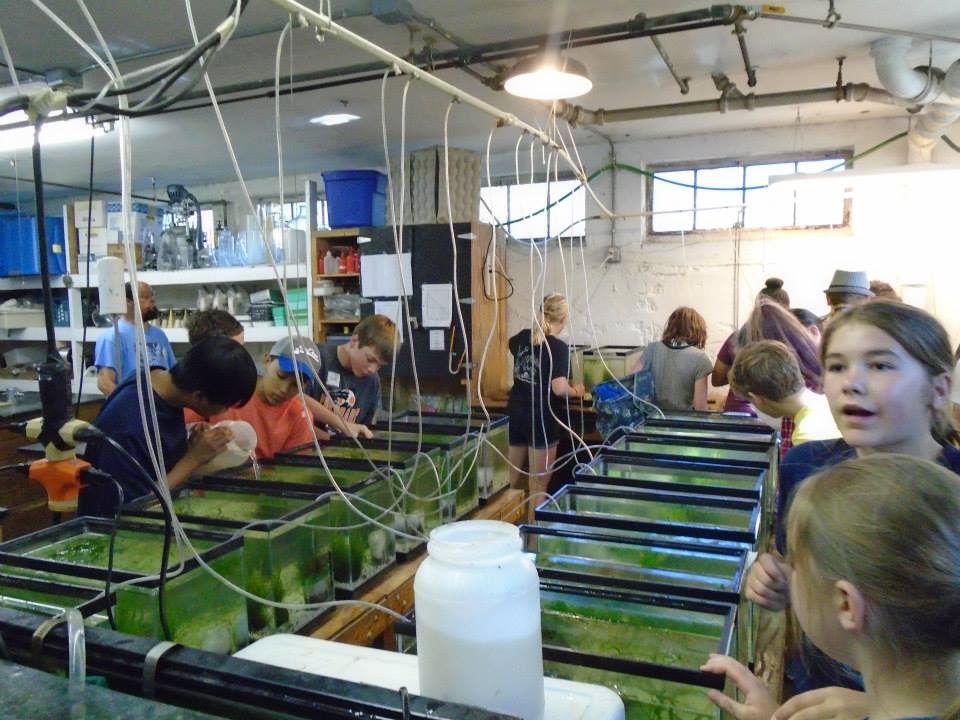
Everyone at AIO shares an aquarium tank with a partner. You collect things to put in your tank and then you have to go study your tank and make sure everything stays alive. This includes checking temperature, density, and salinity (the amount of salt in the water, which is usually measured in parts per million, or ppm.) It is important to make sure that the food chain in the tank is sustainable. You have to make sure that you have the right amount of producers (phytoplankton and algae), primary consumers (organisms like periwinkle snails, limpets, scuds, barnacles, and mussels), and secondary consumers (whelks, sea stars, and crabs). Arguably the most important organism in a tank is algae. Algae is defined as a unicellular or multicellular autotroph (something that photosynthesizes). They live in water, close enough to the shore to receive the sunlight they need. Algae are living organisms but are not defined as animals or plants. Algae are commonly known as seaweed. Algae is at the bottom of the food chain. It also provides oxygen through photosynthesis and gives many animals a place to live. As you can see, algae are very important to the ocean, but you need algae too! Sushi is wrapped in a layer of algae, and some toothpaste and soaps have algae in them too. 
The lab, where all the tanks are

Every night, we listen to at least one lecture, sometimes two. Each one focuses on a specific topic, such as whales, world fisheries, Jacques Cousteau, or birds of prey. I promise to post about what I've learned from some of these lectures later. 

On Sunday, we went on a whale watch but, unfortunately, didn't see any whales. We went back yesterday, and after looking at some puffins, seals, and porpoises, we were lucky enough to see a humpback whale mother and calf. We watched the whales surface, and the not-so-little baby whale really put on a show. We saw at least three full body breaches, as well as several other half body breeches. The whales also showed off their tail flukes for us! The crew of the boat was able to identify the mother whale as Fundy, a whale they had seen before. She was first spotted near the Bay of Fundy, which is how she got her name. They had never seen the calf before, and they are very glad to know that the whale population is still on the rise. The Humpback whales, or Megaptera novaenglae (which means giant winged New Englander), are a recovering species. The whales were so wonderful to watch and I am so glad to hear that we will be able to see them for many years to come. 
Crabs that we collected


Lastly, the other day we went on a crab survey. Before we left, we learned about native crabs (those that are made for the area they live in) and also some invasive species of crabs (those that have traveled into an area and adapted to live there). They are called invasive because, much like the Romans, they take up a lot of space and push the native crabs out. We collected as many crabs as we could in two minutes within a two and a half meter area. We then moved down a little bit and found thirty green crabs and only two Jonah crabs along our fifteen-meter piece of the rocky shore. Green crabs are an invasive species and have clearly invaded the area. Jonah crabs are native to the area, and we were surprised that they only represented a small portion of our data. We measured and identified all he crabs before setting them back in the rocks. 
I have been having so much fun here, I can't believe how quickly it's coming to an end! I'll miss it here!
Next week I'll be at hockey camp, but when I come back I'll be blogging about many more details of things I studied at AIO, including "some things you didn't know about Jacques Cousteau, and some things you did." 

Monday, June 29, 2015

Acadia Institute of Oceanography

Hello!
I am on my way the Acadia Institute of Oceanography in Seal Harbor, ME, near Bar Harbor. I will be spending the next two weeks participating in the AIO Intermediate program. I have never been there before, and I am so eager to learn more about fish, the ocean and being a marine biologist!
I've read that there will be labs, hiking, tide pooling, snorkeling, night walks by the shore and much, much more. I will be studying tide pool diversity, water samples, and some specimens we find! Cool, right?
I will post about things I'm learning, but I may not be able to download pictures right away. However, if you go to the AIO website you'll be able to see some pictures of the activities I'll be doing.
I chose Acadia because it has so many great opportunities to learn about marine concepts, and it is located near the easternmost point of the US and looking right out onto the North Atlantic Ocean, there are sure to be some incredible marine environments all around me. Plus, every time I talk to someone who has gone to AIO, I get even more excited!
I cannot wait to get to camp! More blog posts from Acadia!
--

Sunday, June 14, 2015

Blandings Turtles Release

Hello everybody,
I'm finally out of school, and yesterday I was able to set free the two Blanding's turtles that my class at school head started. To check out my previous post on these turtles, click here.
The two turtles, Cinnamon and Sugar, were about the size of a quarter when we received them, and they have grown so much over the past school year. Now, they each weigh around 75-85 grams, around the size of my fist! During the school year, my cousin, my close friend, and I spent our Friday afternoons with the turtles. We quickly became the 'turtle mommies' as we bonded with the turtles. Now, eight months after we first saw them, it was hard to say goodbye.
Cinnamon and Sugar were born in the Assabet River Fish and Wildlife Refuge, near Stowe, MA, and were sent to our school as part of the head start program. The goal of the program is to grow turtles in healthy environments so that when they are released in the wild, many of their predators are eliminated because the turtles are much bigger. The Blanding's Turtles were endangered at one point, and the turtles with only a 26% survival rate. The 110 turtles who were head started this year have an 80-90% survival rate- almost three times as high!
When we arrived at the refuge, we walked out to the mash area and stopped for a few minutes as the guide showed us two of the traps he had designed. They were used to keep track of turtles, and were made to keep snapping turtles out but let the smaller turtles in. There was a Painted Turtle in one of the traps, and he told us that people sometimes confuse the Blanding's and Painted Turtles. Painted Turtles have yellow stripes on their neck, whereas the underside of a Blanding's Turtle's neck is completely yellow. After setting the Painted Turtle back into the water, we walked down a little further to where we would be setting our turtles free. As the guide stepped out of the car, he had a box with him. He took the lid off, and I instantly knew who it was. "Sun?" I asked. He nodded, handing me the turtle. Sun was one of the two turtles I raised last year. He was so big when we set him free, that they wanted to put a tracker on him. We were able to look at a sheet of the size and weight of Sun over the past year. The guide told us that Sun was the biggest Blanding's Turtle of her age group.
After taking a ton of pictures, we weighed the turtles. We also recorded the carapace (top of the shell) length and width, plastron (underside of the shell) length and width as well as the height of the turtle. Then, with our last goodbyes, we set the turtles  down into the marsh and watched them swim away. Good luck, Cinnamon and Sugar!